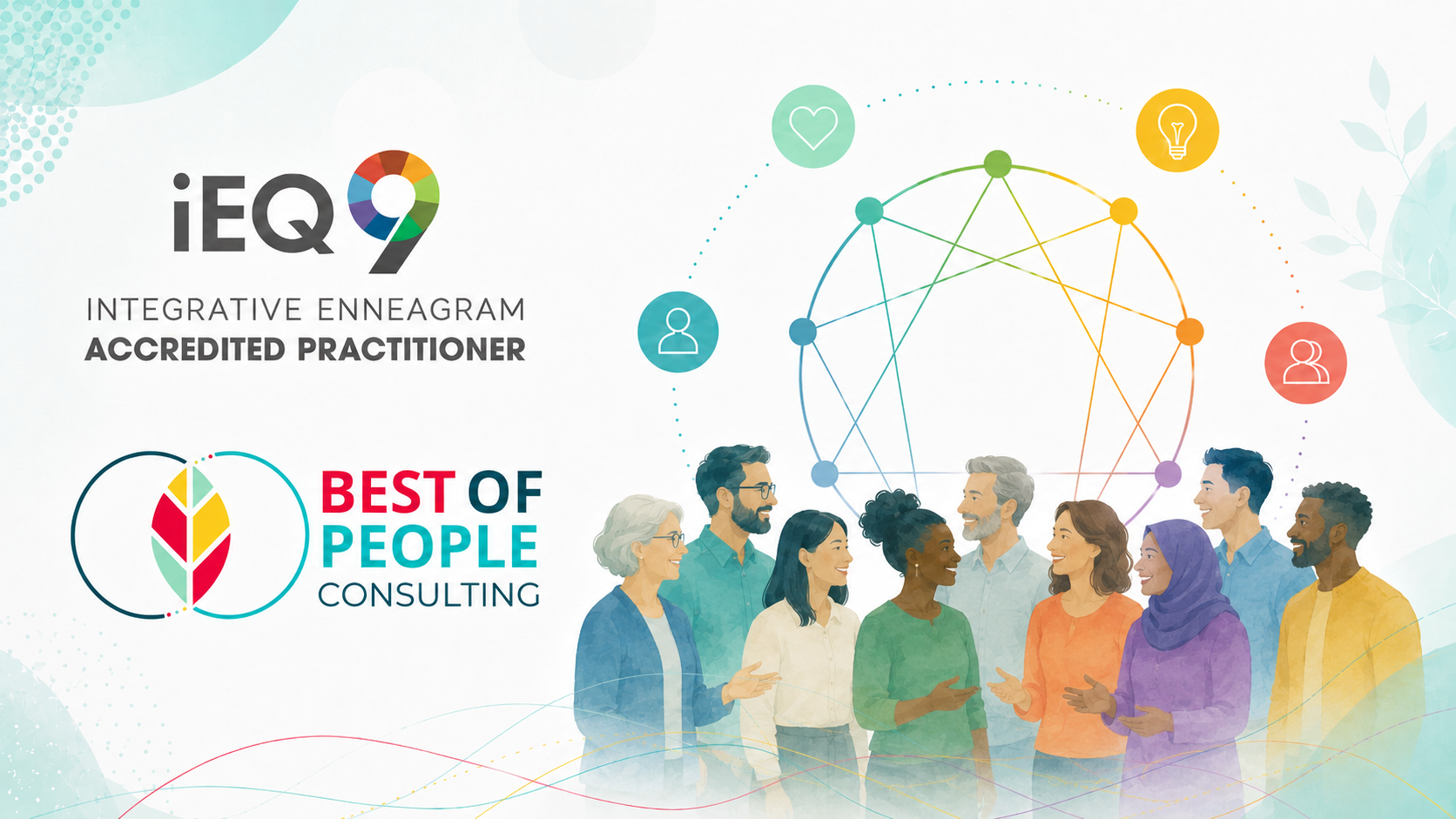
Using the Enneagram for Real Team Effectiveness
Best of People Consulting | Practitioner Insight
Most teams are not ineffective because they lack technical skill. They struggle because the human side of work is hard. People misread each other’s intentions, avoid difficult conversations, default to unhelpful patterns under pressure, and operate from assumptions that were never made visible. The result is wasted energy, fractured trust, and outcomes that fall short of what the team is genuinely capable of.
At Best of People Consulting, our Team Effectiveness workshops use the Enneagram as the central lens for this work. Not because it is a trend, but because it is one of the most sophisticated and practically useful frameworks available for helping people understand themselves, understand others, and change the way they work together.
This article explains what the Enneagram is, why we choose it for team development, when a Team Effectiveness workshop is the right intervention, and what the process looks like in practice.
What Is the Enneagram?
The Enneagram is a dynamic model of human personality that describes nine distinct patterns of thinking, feeling, and behaving. Each pattern, known as a type, reflects a deeply held worldview, a core motivation, and a set of habitual responses that develop over a lifetime. Unlike many personality tools that describe what you do, the Enneagram explains why you do it.
The nine types are not rigid categories. They exist within a rich system of interconnections, subtypes, wings, and growth and stress pathways that make the model both nuanced and highly personal. The aim is never to box people in, but to help them see themselves more clearly, including the patterns that no longer serve them.
In the organisational context, the Enneagram gives teams a shared language for the invisible dynamics that shape how they function. Why does one colleague go quiet in conflict? Why does another over-prepare for every meeting? Why does someone who genuinely cares about the team still come across as controlling? These are not personality flaws. They are patterns, and patterns can be understood, named, and worked with.
The Enneagram does not tell you what someone is capable of. It illuminates what might be getting in the way.
Why the Enneagram for Team Effectiveness?
There are many personality and behavioural instruments available for team development. So why the Enneagram?
It goes beneath behaviour
Most frameworks describe observable behaviour. The Enneagram goes a step further, addressing motivation. Two people can behave in exactly the same way for completely different reasons, and that difference matters enormously in a team context. Understanding what drives a colleague, not just what they do, changes the quality of the conversation you are able to have with them.
It normalises difference without flattening it
Teams often struggle with difference. What one person experiences as conscientious, another experiences as perfectionist. What one person calls direct, another calls harsh. The Enneagram helps teams see that these differences are not personal attacks or character defects. They are predictable expressions of different internal worlds. This does not mean anything goes, but it does create the psychological safety needed to have honest conversations about impact and behaviour.
It creates insight that transfers
Enneagram work does not stay in the workshop room. Because it speaks to core motivation, the insights tend to stick. Participants consistently report that months later, they notice their own patterns more quickly, recover from unhelpful responses more easily, and are more generous in how they interpret the behaviour of others.
It is rooted in a robust body of research
We use the iEQ9, the Integrative Enneagram Questionnaire developed by Integrative Enneagram Solutions. The iEQ9 is one of the most extensively validated Enneagram instruments available, with a strong research base and adaptive reporting that produces results tailored to each individual. It is a sophisticated tool that takes the guesswork out of type identification and provides rich data for both individual reflection and team-level insight.
It resonates across cultures
In the Southern and African contexts in which we work, we have found the Enneagram to be both accessible and deeply relevant. Its focus on the inner world, on how we relate to others, and on the patterns that connect and divide us aligns closely with the relational values many of our clients bring to their teams. The model travels well across difference.
When Is a Team Effectiveness Workshop Appropriate?
A Team Effectiveness workshop is a significant investment of time, attention, and trust. It is not the right intervention in every situation. The following are contexts in which it adds real value.
The team is functional but wants to perform at a higher level
Not every team that comes to us is in crisis. Many are competent, reasonably cohesive teams that want to move from good to great. They want to understand each other more deeply, have more honest conversations, and unlock the kind of collaboration that produces genuinely exceptional work. This is some of the most energising work we do.
The team is experiencing persistent friction
When the same frustrations keep surfacing, when tension between specific individuals is affecting the team’s functioning, or when communication patterns feel stuck, the Enneagram provides a constructive framework for understanding what is driving the friction. It externalises the problem so that the team can address the pattern rather than attacking the person.
The team is going through significant change
Restructuring, new leadership, shifts in strategy, or rapid growth all place teams under pressure. Change amplifies existing patterns. The person who manages uncertainty by controlling outcomes becomes more controlling. The person who responds to pressure by withdrawing becomes less visible just when the team needs their voice. An Enneagram-based workshop at a point of transition helps teams understand and navigate these dynamics consciously.
A new team is forming
Teams that invest in understanding each other early build trust faster. When a new team takes the time to explore each other’s working styles, communication preferences, and stress responses before problems emerge, they establish norms that serve them well through the inevitable challenges ahead.
The team has leadership responsibilities
For leadership teams in particular, the stakes of poor self-awareness and poor interpersonal understanding are high. The patterns of a leadership team ripple throughout an organisation. Helping leaders see how their type-based tendencies show up in their leadership style, how they respond to pressure, and how they are experienced by others is work with significant organisational leverage.
A note on readiness: For a Team Effectiveness workshop to succeed, the team needs a basic level of psychological safety and a genuine intention to engage honestly. Where there is significant unresolved conflict, active hostility between team members, or a leader who is not willing to participate as a learner alongside their team, the work needs a different entry point. We spend time assessing readiness before we design.
What Does the Process Look Like?
No two workshops are identical. We design for the specific team, context, and objectives in front of us. That said, our process typically includes the following elements.
Pre-work: iEQ9 assessments
Each team member completes the iEQ9 before the workshop. The iEQ9 is an online questionnaire that takes approximately 30-35 minutes to complete. It produces a detailed individual report covering Enneagram type, wings, subtypes, integration and disintegration pathways, and a range of developmental insights. Participants receive their reports in advance of the workshop and are encouraged to read them reflectively, noting what resonates and what raises questions.
Discovery: individual reflection and type exploration
The workshop begins with each person deepening their understanding of their own type. We explore the core motivation of each type, the gift it brings, and the shadow it can cast. This is done in a way that is affirming rather than exposing, holding each type with genuine respect for what it brings to the world and to the team.
Team mapping: understanding the type mix
We then map the team’s profile collectively. This is often one of the most illuminating parts of the day. Teams begin to see the strengths that come naturally from their composition, the blind spots that are almost certainly present, and the dynamics that play out between types. The question shifts from “what is wrong with this person” to “what does our type mix mean for how we work together”.
Application: working with real team dynamics
We move from insight to application. Using real scenarios drawn from the team’s actual context, we explore how different types show up in meetings, in conflict, in decision-making, and under pressure. This is where the Enneagram stops being a personality tool and becomes a practical resource for everyday working relationships.
Commitments: naming what will be different
Workshops that do not end with concrete commitments rarely change behaviour. We close with each individual and the team as a whole naming specific, observable changes they will make. Not vague intentions, but real commitments: what I will do differently, what I will stop doing, and what I am asking the team to hold me accountable for.
What a Team Effectiveness Workshop Is Not
It is worth being clear about the boundaries of this work, because clarity here protects both the team and the integrity of the process.
• It is not therapy. The Enneagram surfaces deep patterns, but a team workshop is not the place to process personal history or unresolved trauma. We create a container that is developmental and professionally safe, not a therapeutic one.
• It is not a substitute for addressing structural problems. If the team’s challenges are rooted in poor systems, unclear roles, or inadequate resources, no amount of self-awareness will fix them. The Enneagram addresses the human dynamics layer, not the organisational design layer.
• It is not a one-off event. A single workshop creates awareness and momentum. Sustained change requires follow-through: integration conversations, coaching, and leadership that models the commitments made in the room.
• It is not about using the Enneagram as a label. “Oh, she’s a Type 8, that’s why she’s difficult” is a misuse of the model. The Enneagram is a tool for compassion and accountability, not an excuse for fixed behaviour.
What Shifts When Teams Do This Work?
The changes we most consistently observe after Enneagram-based team work are not dramatic or immediate. They are quiet, cumulative, and durable. Teams report:
• More considerate interpretations of each other’s behaviour under pressure
• Greater willingness to name what is not working, with less fear of damaging the relationship
• A shared language that makes difficult conversations easier to navigate
• Leaders who are more self-aware about their own contribution to team dynamics
• A genuine sense of being known, and of knowing, the people they work with every day
This last point is not a soft outcome. In the research on team effectiveness, trust and psychological safety are among the strongest predictors of high performance. The Enneagram builds both, because it invites people to be honest about who they really are, and creates the conditions in which that honesty is received with curiosity rather than judgement.
Teams do not become effective because they agree on everything. They become effective because they understand each other well enough to work through disagreement.
A Final Word
We believe in the Enneagram because we have seen what happens when people stop defending their patterns and start understanding them. Something becomes possible in a team that was not possible before: honest conversation, genuine collaboration, and the kind of trust that does not collapse under pressure.
The teams we are most proud to have worked with are not the ones that had the easiest workshops. They are the ones that had the courage to look honestly at how they were functioning, to stay in the room when it got uncomfortable, and to leave with real commitments rather than polite resolutions.
That is the work. And in our experience, it is worth doing.
Best of People Consulting | bestofpeople.co.za
Carin Bergh is an iEQ9 Accredited Practitioner and IO Psychologist at Best of People Consulting.